Most insurance agencies do not start out thinking about outsourcing operations.
In the early days, the team is small, and everyone knows what is going on. Producers write policies, the service team helps clients, and someone keeps the paperwork from getting out of control. It works because the book of business is still manageable.
But then the agency grows. More policies. More renewals. More emails. More documentation.
At first, it feels like a good problem to have. Growth usually is. But over time, the operational side of the business starts getting heavier.
The Situations Agency Owners Start Noticing
Here is the interesting part. Most agency owners do not sit down in a strategy meeting and decide to outsource their back office.
Instead, they start noticing patterns inside the office. Small things that keep happening. Moments where people who should be focused on clients or sales are stuck handling administrative challenges.
If you have been running an agency for a while, a few of these scenarios might sound familiar.

Scenario One: Producers Are Handling Administrative Tasks Between Sales Calls
Picture a typical day for a producer.
They finish a call with a client. Good conversation. Maybe even a new policy in the works. Then they glance at their inbox before jumping into the next call.
There is a certificate request waiting there. It will only take a few minutes, right? So they handle it.
Later that afternoon, they update a policy note in the agency management system. Then they track down a missing document for an upcoming renewal.
None of these tasks seem time consuming, and that’s the problem.
They slip into the day quietly. Five minutes here. Ten minutes there.
But over time, those minutes add up. And slowly, almost without anyone noticing, producers start spending less time selling and more time managing files.
Scenario Two: The Service Team Always Feels Busy, but Work Still Piles Up
Most service teams in insurance agencies work incredibly hard.
They respond to client questions. They process policy changes. They issue certificates. They handle endorsements and documentation. And they try to do it all quickly because clients expect fast answers.
So what happens when the workload grows? Well, something interesting often occurs.
The team stays busy all day. In fact, they may feel busier than ever. But somehow the work still seems to pile up.
Have you ever had one of those days where you worked nonstop but your to-do list somehow got longer instead of shorter? That is what many service teams experience as agencies grow.
And usually it is not a performance problem. It is simply a capacity problem.
Scenario Three: Renewals and Documentation Are Taking More Time Than Expected
Renewals are the heartbeat of an insurance agency. They keep revenue consistent, and they require careful attention.
Policies need to be reviewed. Documentation needs to stay accurate. Communication with carriers and clients has to remain organized.
But there is another layer that often adds more time than expected.
When rates increase or carriers decide not to renew a policy, the team has to step in and shop the renewal. That means reaching out to multiple carriers, comparing options, preparing updated quotes, and communicating those changes clearly to the client.
Shopping renewals is not a quick task. It requires attention to detail, follow-ups, and careful coordination, especially for agencies handling home and auto policies where this happens more frequently.
As a result, renewal preparation starts taking up a larger portion of the team’s time than anyone expected.
Owners sometimes notice this slowly. A renewal that used to take ten minutes now takes thirty. A quick review turns into a deeper administrative process.
Multiply that across hundreds or thousands of policies, and suddenly renewals become a major operational project.
Scenario Four: The Agency Owner Is Spending More Time Managing Operations
Here is a question many agency owners eventually ask themselves.
“When did I start spending this much time dealing with operational details?”
In smaller agencies, owners often stay involved in day-to-day operations. It makes sense. The team is small, and jumping in keeps things moving.
But as the business grows, those small operational responsibilities can quietly expand.
Instead of focusing on strategy or partnerships, the owner might find themselves fixing small administrative issues throughout the day.
And it’s perfectly normal to want to step in and sort these issues out. But when they start filling up large parts of the day, something has shifted.
It is often one of the clearest signals that the operational side of the agency has become larger than the current structure was designed to handle.

When These Situations Start Appearing Regularly
Any one of these situations can happen occasionally in a healthy agency.
But when they start showing up regularly, many agency owners begin to notice a pattern. Administrative work has quietly grown into a much larger part of the business. And at that point, the question becomes pretty simple.
Do we keep asking the same team to absorb more operational work? Or do we add support to handle it?
For many agencies, this is where the idea of insurance back office support starts making sense.
This is because the agency has reached a stage where additional operational structure helps restore balance.
How Virtual Assistants Can Help With Insurance Back Office Tasks
When agencies begin feeling operational pressure, the issue is rarely the core work of the business. Producers haven’t forgotten how to sell, and service teams still know how to help clients.
The real challenge usually sits behind the scenes.
Think about how many small operational tasks an insurance agency generates every single day. They create a steady stream of administrative work that keeps the office running.
That is where virtual assistants providing insurance back office support can help.
Instead of pulling producers or account managers away from their primary responsibilities, many of these tasks can be handled by trained administrative support working remotely.
Virtual assistants can help process routine requests, organize documentation, update systems, and keep operational workflows moving.
For growing agencies, this kind of support works a bit like adding another set of steady hands behind the scenes.
The internal team stays focused on clients and growth while the administrative side of the business continues running smoothly.
So, What Can Actually Be Taken Off Your Team’s Plate?
When people hear “back office support,” the next question is usually pretty straightforward.
What does that actually include?
Because it is one thing to talk about operational pressure. It is another thing to clearly see what can be taken off your team’s plate.
Here is a snapshot of the type of work that can be handled as part of insurance back office support:
- Quoting and proposal generation
- Policy administration and updates
- Certificate of Insurance (COI) processing
- Endorsement handling
- Renewal preparation
- Carrier follow-ups
- Client onboarding and document collection
- Bookkeeping and accounting support
- Claims intake and communication
- Routing coverage questions
- CRM and AMS updates
And more, depending on how your agency is structured.
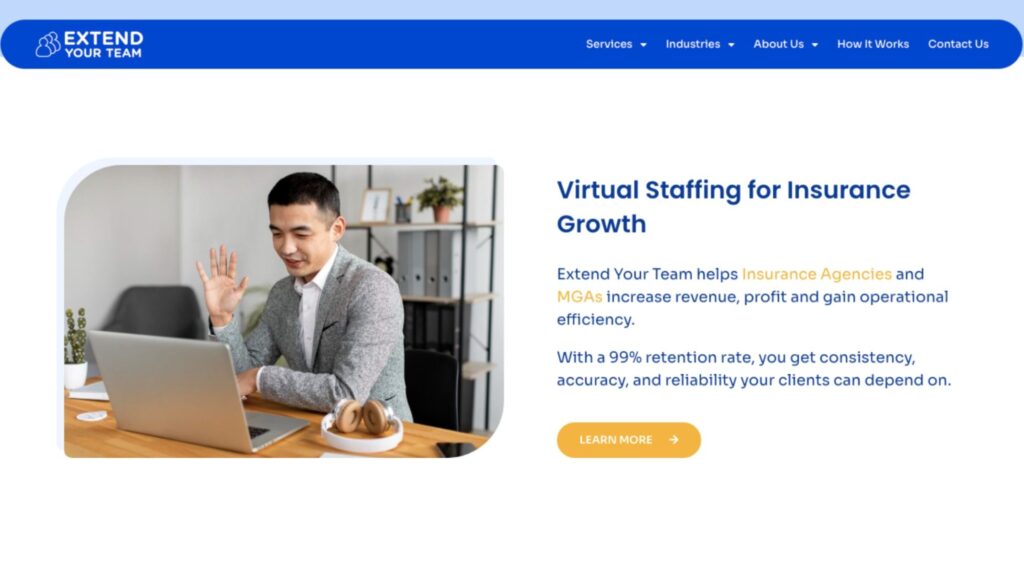
Why Hiring Locally Is Not Always the Best Option
When agencies realize they need additional operational help, the first instinct is often to hire someone locally.
That approach can absolutely work in some situations. But it is not always the simplest solution.
Hiring locally adds another full-time role to the agency. Recruiting takes time. Training requires attention from existing staff. Then there are the long-term commitments that come with payroll, benefits, and employment contracts.
For agencies that are simply trying to increase administrative capacity, that can sometimes feel like solving one problem by creating several new ones.
That is why many agencies explore outsourcing insurance back office support instead.
Virtual assistants allow agencies to add operational support without increasing internal headcount or committing to long hiring cycles.
It gives the agency flexibility.
More capacity when it is needed. Less administrative pressure on the internal team, and the ability to keep everyone focused on the work that actually drives profit.
Bonus: I’ve built a quick Insurance Agency Time Audit to reveal where your time is spent and how much it’s costing you. It only takes 5 minutes, take your audit now.